
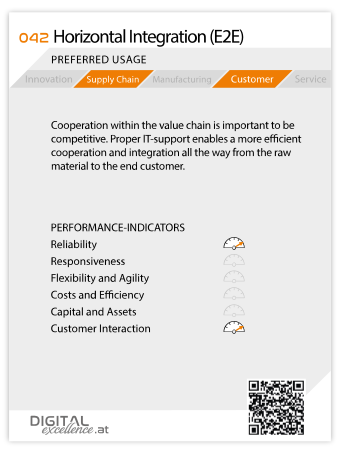
Within a supply chain, all stations inside and outside a company must co-operate in order to provide benefits to the end customer. Staying competitive and ensuring long-term growth possibilities through internal financing is difficult in most consumer goods markets. On the one hand businesses try to reduce steadily costs. On the other hand, there are numerous points of friction on the way from raw material through the processing to the end consumer. Integrating several departments or companies under one structure can reduce transaction costs and assure efficient collaboration. End-to-End integration is an attempt to create an interface-free value chain from raw material to retail through IT platforms, contracts, joint ventures, cross-company structures and smart supply chains. Savings are made at every stage of the supply chain.
- Car production
- Electronic production
- Clothing production
Unternehmenstrategie
Leistungsindikatoren
Digitalisierungsstrategie
Relevenate ESG Indikatoren
EnvironmentalBevorzugter Einsatzbereich
Notwendige Vernetzungsanforderungen
Relevante Umsetzungsherausforderungen
Relevante Technologie-Treiber
Relevante Organisations-Design
Benötigte Kompetenzen - Implementierung
| Schwerpunkt | Area of digital competence | Implementation |
|---|---|---|
| Management | Cross-sectional competencies (change, leadership, ...) | |
| Strategy-focused competencies | Customer focus | |
| Product focus | ||
| Operational focus | ||
| Design, implement and operate digital solutions | Problem-solving skills | |
| Analytics & big-data | ||
| SW-adaption skills | ||
| Programming skills | ||
| Service-skills | ||
| Use digital solutions | Knowledge management & transfer | |
| SW-application skills | ||
| Basic skills of digital appilcations | ||
| Digital basic skills | ||
| Handling of data | Data security |
Benötigte Kompetenzen - Anwendung
| Schwerpunkt | Area of digital competence | Implementation |
|---|---|---|
| Management | Cross-sectional competencies (change, leadership, ...) | |
| Strategy-focused competencies | Customer focus | |
| Product focus | ||
| Operational focus | ||
| Design, implement and operate digital solutions | Problem-solving skills | |
| Analytics & big-data | ||
| SW-adaption skills | ||
| Programming skills | ||
| Service-skills | ||
| Use digital solutions | Knowledge management & transfer | |
| SW-application skills | ||
| Basic skills of digital appilcations | ||
| Digital basic skills | ||
| Handling of data | Data security |
Branchen

HANDY . PRACTICE-ORIENTED . SELF-EXPLENATORY
Links
Contact
