
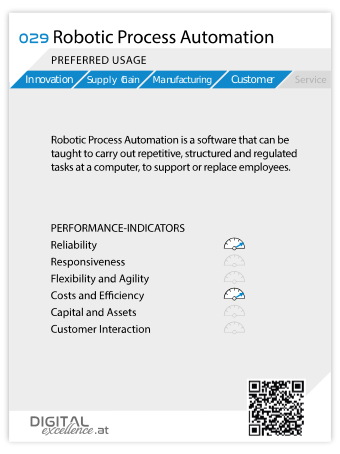
In process automation robots take over tasks from humans in certain sections. Robotic process automation is software that automatically take over tasks in other software. These tasks are usually very structured and are handled according to clear rules. Robots don’t need to be programmed for specific tasks, as they are able to learn and understand the tasks based on solely observing the steps and the input of rules which are relevant for the task. Robots don’t operate through separate software interfaces; they act like human users through the user interfaces of the program. The level of automation can differ: Depending on the task at hand individual robots on a computer can be customized to an employee or an entire RPA system can be used.
- User data analysis (FB, AMZ)
- Data entry (providers like PWC, KPMG)
- Data processing in Excel, Access, etc.
Unternehmenstrategie
Leistungsindikatoren
Digitalisierungsstrategie
Relevenate ESG Indikatoren
EnvironmentalBevorzugter Einsatzbereich
Notwendige Vernetzungsanforderungen
Relevante Umsetzungsherausforderungen
Relevante Technologie-Treiber
Relevante Organisations-Design
Benötigte Kompetenzen - Implementierung
| Schwerpunkt | Area of digital competence | Implementation |
|---|---|---|
| Management | Cross-sectional competencies (change, leadership, ...) | |
| Strategy-focused competencies | Customer focus | |
| Product focus | ||
| Operational focus | ||
| Design, implement and operate digital solutions | Problem-solving skills | |
| Analytics & big-data | ||
| SW-adaption skills | ||
| Programming skills | ||
| Service-skills | ||
| Use digital solutions | Knowledge management & transfer | |
| SW-application skills | ||
| Basic skills of digital appilcations | ||
| Digital basic skills | ||
| Handling of data | Data security |
Benötigte Kompetenzen - Anwendung
| Schwerpunkt | Area of digital competence | Implementation |
|---|---|---|
| Management | Cross-sectional competencies (change, leadership, ...) | |
| Strategy-focused competencies | Customer focus | |
| Product focus | ||
| Operational focus | ||
| Design, implement and operate digital solutions | Problem-solving skills | |
| Analytics & big-data | ||
| SW-adaption skills | ||
| Programming skills | ||
| Service-skills | ||
| Use digital solutions | Knowledge management & transfer | |
| SW-application skills | ||
| Basic skills of digital appilcations | ||
| Digital basic skills | ||
| Handling of data | Data security |
Branchen

HANDY . PRACTICE-ORIENTED . SELF-EXPLENATORY
Links
Contact
