
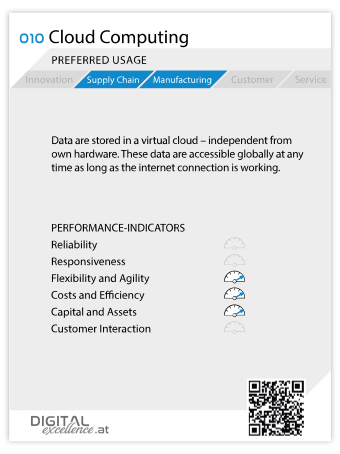
Cloud computing enables the storage of data independent from own hardware. Basis is the internet. Cloud-based solutions can offer three different type of services. The charging model is usually pay-per-use. Software as a Service (Saas) is the uppermost service layer and contains the provision of software to use. Platform as a Service (PaaS) is the middle service layer and offers the foundation for developers to offer databases and software. Infrastructure as a Service (IaaS) is the third layer providing the customer with computer power, storage and network infrastructure. The use of cloud computing decreases the costs for maintenance and administration of local storages. Mobile offices are a use case for cloud computing as data are available everywhere requiring a valid internet connection. This service is different between private clouds, accessible only internally and public clouds offered in the internet. A combination of both is called hybrid cloud.
- Dropbox
- Google Drive
- iCloud
- ERP on Demand
- Private Cloud
Unternehmenstrategie
Leistungsindikatoren
Digitalisierungsstrategie
Relevenate ESG Indikatoren
EnvironmentalBevorzugter Einsatzbereich
Notwendige Vernetzungsanforderungen
Relevante Umsetzungsherausforderungen
Relevante Technologie-Treiber
Relevante Organisations-Design
Benötigte Kompetenzen - Implementierung
| Schwerpunkt | Area of digital competence | Implementation |
|---|---|---|
| Management | Cross-sectional competencies (change, leadership, ...) | |
| Strategy-focused competencies | Customer focus | |
| Product focus | ||
| Operational focus | ||
| Design, implement and operate digital solutions | Problem-solving skills | |
| Analytics & big-data | ||
| SW-adaption skills | ||
| Programming skills | ||
| Service-skills | ||
| Use digital solutions | Knowledge management & transfer | |
| SW-application skills | ||
| Basic skills of digital appilcations | ||
| Digital basic skills | ||
| Handling of data | Data security |
Benötigte Kompetenzen - Anwendung
| Schwerpunkt | Area of digital competence | Implementation |
|---|---|---|
| Management | Cross-sectional competencies (change, leadership, ...) | |
| Strategy-focused competencies | Customer focus | |
| Product focus | ||
| Operational focus | ||
| Design, implement and operate digital solutions | Problem-solving skills | |
| Analytics & big-data | ||
| SW-adaption skills | ||
| Programming skills | ||
| Service-skills | ||
| Use digital solutions | Knowledge management & transfer | |
| SW-application skills | ||
| Basic skills of digital appilcations | ||
| Digital basic skills | ||
| Handling of data | Data security |
Branchen

HANDY . PRACTICE-ORIENTED . SELF-EXPLENATORY
Links
Contact
