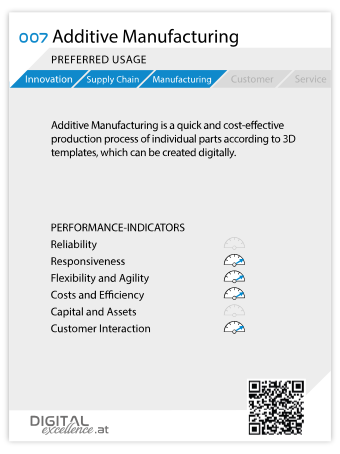

Likewise known as "generative manufacturing", additive manufacturing describes all professional manufacturing processes which produce individual parts, models or prototypes using a carrier material. Depending on the end product, liquids, plastics or powders are layered until the final shape is achieved. Digital data models of the product itself serve as templates and enable production on demand as well as a simple transfer of templates.
One of the advantages resulting from this production is the possibility of fast prototyping, manufacturing of single pieces or special parts. By selecting proper material, it is possible to achieve a weight advantage of up to 50% compared to common milling or casting processes. In addition, the production speed and costs for highly complex parts can be significantly reduced. So far, it is the only process whose cost-effectiveness increases with increasing complexity of the end product.
- 3D Printer
- Generative lightweight construction
- Spare parts
- Rapid Prototyping
- Rapid Product Development
Unternehmenstrategie
Leistungsindikatoren
Digitalisierungsstrategie
Relevenate ESG Indikatoren
EnvironmentalBevorzugter Einsatzbereich
Notwendige Vernetzungsanforderungen
Relevante Umsetzungsherausforderungen
Relevante Technologie-Treiber
Relevante Organisations-Design
Benötigte Kompetenzen - Implementierung
| Schwerpunkt | Area of digital competence | Implementation |
|---|---|---|
| Management | Cross-sectional competencies (change, leadership, ...) | |
| Strategy-focused competencies | Customer focus | |
| Product focus | ||
| Operational focus | ||
| Design, implement and operate digital solutions | Problem-solving skills | |
| Analytics & big-data | ||
| SW-adaption skills | ||
| Programming skills | ||
| Service-skills | ||
| Use digital solutions | Knowledge management & transfer | |
| SW-application skills | ||
| Basic skills of digital appilcations | ||
| Digital basic skills | ||
| Handling of data | Data security |
Benötigte Kompetenzen - Anwendung
| Schwerpunkt | Area of digital competence | Implementation |
|---|---|---|
| Management | Cross-sectional competencies (change, leadership, ...) | |
| Strategy-focused competencies | Customer focus | |
| Product focus | ||
| Operational focus | ||
| Design, implement and operate digital solutions | Problem-solving skills | |
| Analytics & big-data | ||
| SW-adaption skills | ||
| Programming skills | ||
| Service-skills | ||
| Use digital solutions | Knowledge management & transfer | |
| SW-application skills | ||
| Basic skills of digital appilcations | ||
| Digital basic skills | ||
| Handling of data | Data security |
Branchen

HANDY . PRACTICE-ORIENTED . SELF-EXPLENATORY
Links
Contact
